The subterranean Antithesis nest
Tinea and Leah: [Cyberpunk, Alien Incursions, Murder and Mayhem, Girl's Love (WLW)]The subterranean Antithesis nest is a concealed Antithesis breeding site beneath Saint-Eustache in New Montreal and a future target of Tinea and Leah's campaign. It matters not merely as a place to clear, but as the point where an alien social organism reproduces, judges its young, stores food, and extends its threat underground; destroying it therefore combines ecological containment, military planning, and resource gathering.
Location and Hidden Life
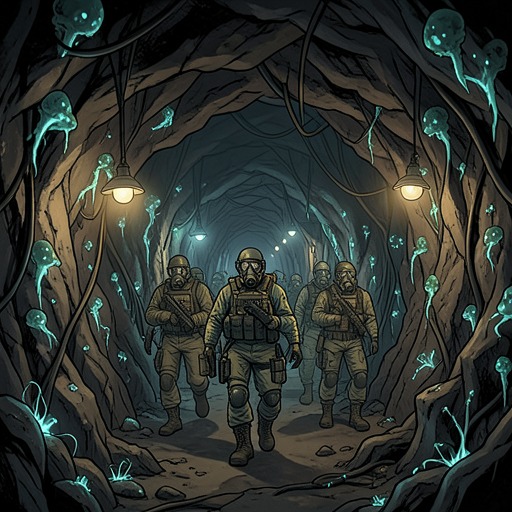
The nest lies in the bowels of Saint-Eustache, New Montreal, beneath the ramp leading up into the megacity proper. Its existence is introduced through Antithesis perception rather than human mapping. An Antithesis unit follows the scent of meat-food through the buried spaces, reading the world through air, taste, and chemical trails. It carries a piece of food back toward its home-place, marking the route with food signals as it travels along established hunting and danger trails.
The nest is also a reproductive center. When the returning unit reaches home-place, it passes birth-wood as birth-fluid sacks break open and newly formed Antithesis emerge. Other units inspect the new young by scent. The nest's communal logic is therefore biological and collective: resemblance and familiar smell establish belonging, while abnormality is treated as an immediate threat. One badly grown young is identified as sick and wrong, attacked, and rapidly torn apart by the others. The scene presents the nest as an organized living system with its own sensory language, food economy, reproductive process, and harsh internal norm.
Discovery and Threat
The nest's underground position makes it difficult to approach as an ordinary battlefield target. It is not simply another visible Antithesis formation; it is a hidden source from which future nests and units may continue to emerge. That latent danger explains why its destruction is planned even while Tinea and Leah are occupied with more immediate preparation and combat. The nest represents the enemy's capacity to persist beneath settled human space, close to the infrastructure linking Saint-Eustache to New Montreal.
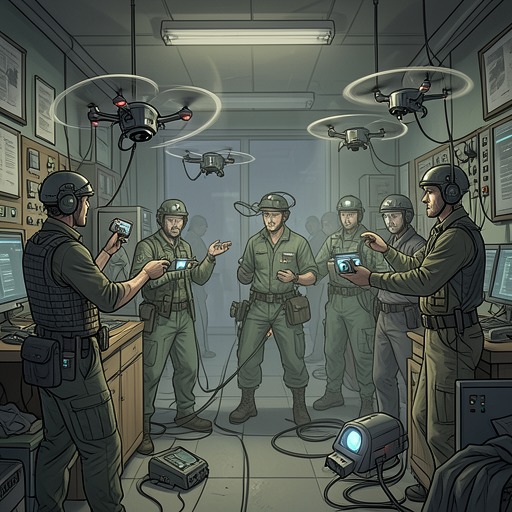
Its significance also emerges through contrast with the human surveillance network around the suburb. Tynea maintains records from a reactivated eight-legged drone on a condominium roof, analyzes sensor anomalies, and preserves information for later use. The drone's earlier investigation of unusually quiet hovervans was frustrated by automated digital retaliation, showing that observation in this environment is contested and technologically mediated. Against that background, an underground Antithesis nest is both a biological hiding place and a problem of reconnaissance: it must be located, surveyed, and attacked through a chain of machines and delegated decisions.
Planned Destruction
Tinea and Leah explicitly mark the underground nest for destruction as they calculate the resources needed for their next operations. Tynea explains that destroying it will yield only around eight percent of its actual point value, with another two percent available if the nest is personally tagged. The relatively low return means that the nest is not treated as an effortless point farm. Its military value and containment value must be weighed against the time and effort required to reach it.
The operational plan is more systematic than a direct assault. Advice calls for a swarm of drones to scout the underground nest and then for an RFG bombardment. The drone swarm is itself listed for disposal afterward, indicating that reconnaissance assets are considered expendable once they have revealed the target or guided the strike. The plan also includes synthesizing Pulvinophages, bacteria intended to attack plant muscles, and seeding nutrition jars with them. These preparations connect the nest's destruction to a broader attempt to deny the Antithesis biological resources and prevent genetic traces from remaining after the attack.
The weapons network makes such a plan possible. The Sentinel can be entrusted with command and automatic fire, while Tynea handles administrative configuration rather than forcing Tinea to debug systems in combat. The Myriad's interface offers autonomous battle mode, threat detection, configurable settings, sensor readings, ammunition counts, and manufacturing information; its available materials can produce roughly a thousand high-explosive mini-missiles but only ten nanite missiles. Tinea's Quanta can also perceive networked weapons and tools across several kilometers and coordinate projectile-programming facilities and smart bullets. The nest is consequently targeted not by one weapon alone but by an interconnected system of drones, artificial intelligence, ammunition, biological agents, and point-based planning.
Military and Narrative Significance
The subterranean Antithesis nest concentrates the book's recurring tension between organic life and technological command. Antithesis units act through scent, instinct, food trails, communal inspection, and reproduction, yet the response to them is equally distributed across nonhuman agents: Tynea organizes information, drones scout, weapons select and pursue targets, and the Quanta broadens Tinea's awareness of the battlefield. Responsibility becomes collaborative and infrastructural rather than belonging to a single fighter.
The nest also exposes the moral and conceptual asymmetry of the conflict. From the Antithesis viewpoint, the site is home-place, birth-place, and a place where food is carried for communal use. From Tinea and Leah's viewpoint, it is a threat and a source of points whose destruction must be scheduled. Neither perspective erases the other: the nest's own internal order makes it more than a blank enemy bunker, while its reproductive function makes leaving it intact dangerous. Its planned eradication therefore carries the novel's characteristic mixture of tactical efficiency, biological horror, and uneasy recognition of a nonhuman society.
By the end of the supplied planning sequence, the nest has not yet been destroyed. It has instead been converted from an obscure underground presence into a concrete objective with a reconnaissance method, a bombardment strategy, expendable equipment, biological preparation, and a place in the party's departure checklist. That unfinished status gives the location a forward pressure: the nest remains beneath Saint-Eustache, hidden but no longer unknown, waiting to become the next test of whether Tinea and Leah's networked arsenal can turn intelligence into containment.